
What Litchfield County Property Value Fields Mean
An assessor figure, a clerk recording, and a sale record each answer a different question. In Connecticut, assessors typically apply a statutory 70 percent factor to a municipal estimate of market value, so any Litchfield County figure only makes sense once its field label and valuation year are attached.
| Value | What It Is | Where |
|---|---|---|
| Appraised or market estimate | The assessor's mass-appraisal estimate as of a revaluation date | Municipal property card |
| Assessed value | The taxable assessment, generally 70 percent of the municipal estimate | Municipal property card and grand list |
| Last sale price | Consideration associated with a dated transfer, subject to deed-type review | Recorded deed and assessor sale row |
| Land and building | Components used to explain the total municipal assessment | Detailed assessor card |
A recent sale and a revaluation rarely land on the same date. Construction, a lot split, or a non-market transfer can change the property in between. Compare like fields only after checking their source dates.
Three Revaluation Years Frame Litchfield County Values
Torrington property cards state a 2024 revaluation. New Milford reports completing one in 2025. Watertown fixes its latest real-estate revaluation at October 1, 2023 and displays the 70 percent assessment relationship, so averaging these separate municipal clocks across Litchfield County would only blur them.
The annual grand list adds another clock. October 1 is Connecticut's key assessment date, yet a portal may refresh later and a deed may record at yet another time. A new owner or a new improvement proves nothing about when the related value fields updated.
Torrington and Watertown Show the 70 Percent Relationship
The documented Torrington training card for 58 Suncrest Court shows $416,600 appraised and $291,620 assessed. That arithmetic is exactly 70 percent. The same card lists land and building facts. It also shows a 2021 warranty-deed row, a 2005 addition, and 2023 solar panels. Each of those details carries its own date. Date them before using the property as a comparison.
Watertown's 47 Clermont Street card shows $279,200 appraised and $195,440 assessed. That is the same 70 percent relationship. Its full-value land and building split is $68,500 and $210,700. Assessed components come to $47,950 and $147,490. These Litchfield County cards explain field structure, not a broad market trend.
Read the Torrington Assessor Value Detail
The official Torrington value-detail record gathers the parcel identity, appraised and assessed amounts, characteristics, sales history, and permits into a single view.
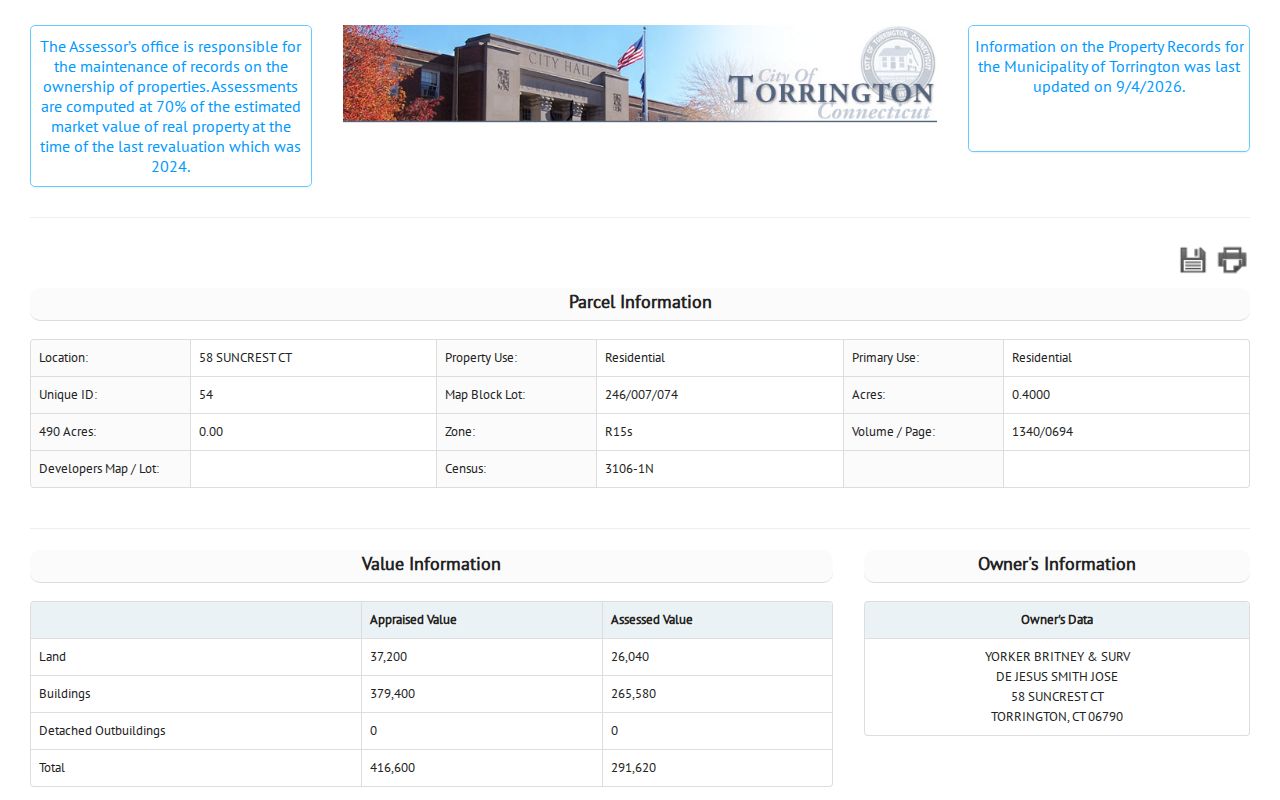
The official page makes the central caution plain: every value field sits beside dates and descriptive data. Copying the amount without those labels strips away the context a comparison needs.
Look Up a Litchfield County Property Value
Begin with the legal municipality, because no Litchfield County appraisal district exists. A postal locality can mislead. Oakville addresses route to Watertown, while Gaylordsville sits within New Milford.
- Search the municipal assessor by location, then save the MBL, list number, or unique ID.
- Copy the appraised, assessed, land, and building fields exactly, together with the revaluation and update dates.
- Open the sale history and note date, amount, and deed reference without assuming each row is an arm's-length sale.
- Read the recorded instrument through the municipal clerk to confirm deed type, parties, consideration, and property interest.
- Compare only parcels with similar date, use, zone, acreage, buildings, and improvement history.
- Assessed value
- The municipal amount used in the tax calculation, tied to a roll date.
- Market or appraised value
- The assessor's mass-appraisal estimate, not a private appraisal.
- Assessment ratio
- The relationship between assessed and full municipal value, documented here at 70 percent.
- Reassessment
- A new valuation cycle that resets the date frame for municipal values.
Why Some Litchfield County Sale Rows Need the Deed
A card history row is a lead, not the final explanation. Torrington examples include $0 rows. Watertown's Loop Road history contains a 2024 Certificate of Notice amount. Neither label should be read as an open-market sale.
Use the volume/page or document reference to open the instrument image. Confirm whether it was a warranty deed, quitclaim, notice, fiduciary transfer, partial interest, or correction. It could also be another filing. Consideration can also reflect circumstances that make it a poor comparable.
Build a Dated Litchfield County Value Comparison
A sound comparison keeps its facts visible. Write down the parcel ID, sale date, instrument type, consideration, revaluation year, full and assessed values, acreage, zone, use, building age and area, and dated permit improvements.
| Comparison field | Why it matters | Official check |
|---|---|---|
| Date and deed type | Separates market transfers from notices or special transfers | Municipal clerk image |
| Acreage and zone | Prevents unlike sites from being grouped | Assessor card and GIS |
| Building and permits | Shows changes that may post after an earlier sale | Card plus building office |
| Revaluation and update | Places the assessment in its correct time frame | Assessor and appeal page |
When a Litchfield County Value Portal Fails
Call or visit the municipal assessor counter with the exact address and parcel identifier. New Milford publishes a street listing and sales links. Torrington and Watertown use town-coded Property Record Cards instead. Ask for the current card and its displayed revaluation date, not a custom appraisal.
For an older value, turn to retained grand lists. Archived property cards and the clerk's transfer record can also help as the municipality permits. Connecticut FOI can request an existing non-exempt record that is not online. But it cannot force an office to create a new value analysis.
Limits of a Litchfield County Assessed Value
An assessor uses mass-appraisal methods for municipal taxation. The figure can lag a fast-moving market, reflect a prior revaluation date, and miss a recent transfer or improvement until the system updates. It also settles nothing about title, parcel boundaries, permit compliance, or the physical condition a private inspection would reveal.
Value is not price. A Litchfield County assessed value serves taxation and does not predict what a property will sell for. It is not an appraisal by a licensed appraiser.
Improvements Can Put Litchfield County Values on Different Dates
Building and land-use records explain why a current card and an older transfer can describe different physical properties. A documented addition, solar installation, new structure, demolition, lot split, or final certificate may sit between the last sale and the current revaluation. Save the permit number, type, issue date, inspection status, final or certificate date, and the tied address or parcel.
Never treat an application as completed work. Torrington separates newer OpenGov records from older address folders. New Milford stresses inspections, final signoffs, and certificates of occupancy. Watertown uses City Squared for several permit types. Match each improvement to its parcel and date before using it to explain a value change.
Mailing Address Does Not Set Litchfield County Value
Mailing addresses can mislead anyone comparing Litchfield County assessments. The Watertown examples make the point clearly. One parcel card lists Oakville as the postal locality even though Watertown holds assessment jurisdiction. Another carries a Brookfield mailing address while the situs sits on Loop Road in Watertown. The mailing city never decides which assessor set the value. Before comparing anything, resolve the legal municipality through GIS and the parcel card. Keep the situs and mailing address stored as separate fields after that. ZIP codes and Census ZCTAs mark delivery routes or statistical areas, not assessment boundaries. They cannot substitute for the town line.
Recorded Consideration Is One Litchfield County Value Clue
A recorded deed's consideration helps date a transfer. But it rarely proves full market value by itself. The stated amount may cover only a partial interest. It might correct an earlier deed. It might involve a fiduciary or reflect some other transaction type entirely. Read any transfer-tax stamp alongside the assessor sale row and the deed itself. For every candidate comparable, record the grantor, grantee, instrument type, recording date, and book/page or document number. Save the stated consideration, legal description, and prior reference too. Flag transactions whose type or conveyed interest differs. Set them aside unless you can explain the gap. This document-first habit matters most for $0 entries and notice documents.