
Litchfield County Property Tax Records
Towns create and collect every property tax bill in Litchfield County. There is no county tax collector. Each assessor builds the October 1 grand list. The local collector then issues bills, posts payments, applies interest, and pursues delinquent accounts. Keep the assessment card and the tax account separate. They answer different questions and can update on different dates.
| Field | What It Shows | Where |
|---|---|---|
| Appraised or market value | Municipal estimate at the revaluation date | Assessor card |
| Assessed value | Roll amount used in the tax calculation | Assessor and grand list |
| Exemption or abatement | Qualifying relief that affects the calculation | Assessor |
| Bill and installments | Amount, due dates, payments, and balance | Municipal tax collector |
| Lien or tax-sale filing | Recorded collection step and status | Collector and municipal clerk |
Sampled Torrington and Watertown property records both apply a 70 percent assessment level, though their revaluation dates differ. The ratio says nothing about what a parcel will fetch on the market. A recorded sale price is simply another dated observation, and exemptions can shift the tax bill without changing the owner of record or the appraised value.
Litchfield County Property Tax Calendar
The Torrington tax-bill guidance places real-estate bills in the mail at the end of June. Bills of $50 or less fall due in full during July. Larger amounts split across July and January, and no second bill goes out for January. For the 2025 grand list, the city lists a July 1, 2026 first installment. Delinquency begins after August 3, 2026.
The 2025 grand-list mill rate sits at 33.46 for real and personal property in Torrington. Rates and dates shift, so hold onto the stated roll year. Sewer accounts run separately, and the city says sewer information stays private unless delinquent. The official Torrington tax route displays the full bill calendar. It also shows the October 1 ownership rule.
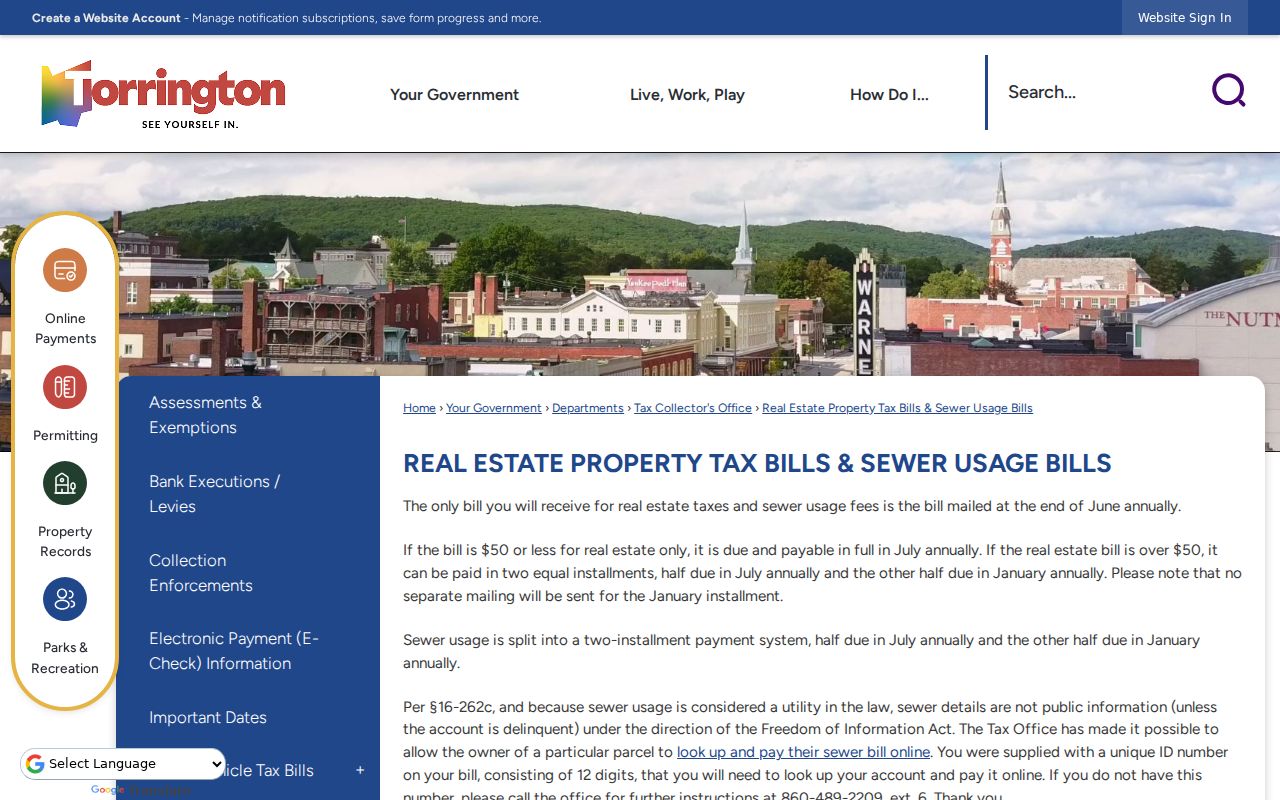
The municipal page shows exactly why a countywide tax lookup would miss the office that actually bills the parcel.
Look Up Litchfield County Property Tax
Start by pinning down the legal town, then open its current tax service from the municipality's own website. Dynamic payment links can change. Search by address, owner, or account key as the portal allows, and match the result to the assessor MBL, list number, or unique ID. A taxpayer or escrow payer name never proves title.
- Use the municipal collector's official route and match the parcel.
- Read the roll year, installment schedule, balance, and posting date.
- Compare the assessed value and any relief with the assessor's dated card.
- If delinquency appears, inspect the clerk's lien or tax-sale filing and later release.
- Assessed value
- The amount placed on the assessment roll for tax use.
- Mill rate
- The local rate applied per thousand dollars of assessed value.
- Exemption
- Statutory relief that can reduce the taxable amount for an eligible claimant.
- Tax lien
- A municipal claim for unpaid tax that may be recorded in land records.
Litchfield County Property Tax Revaluations
Litchfield County has no countywide revaluation date. Torrington states fair market value as of October 1, 2024. Watertown uses an October 1, 2023 revaluation. New Milford reports completion of a 2025 revaluation. The correct property tax record must keep its municipality and valuation date attached.
Torrington's 58 Suncrest Court card lists $416,600 appraised and $291,620 assessed, exactly 70 percent. Its 2021 warranty-deed row lists $299,900. These figures cannot be collapsed: one is a 2024 model estimate, one is the roll amount, and one is an earlier transfer field.
The Torrington value detail displays the appraisal, assessment, sales, building, and permit fields.
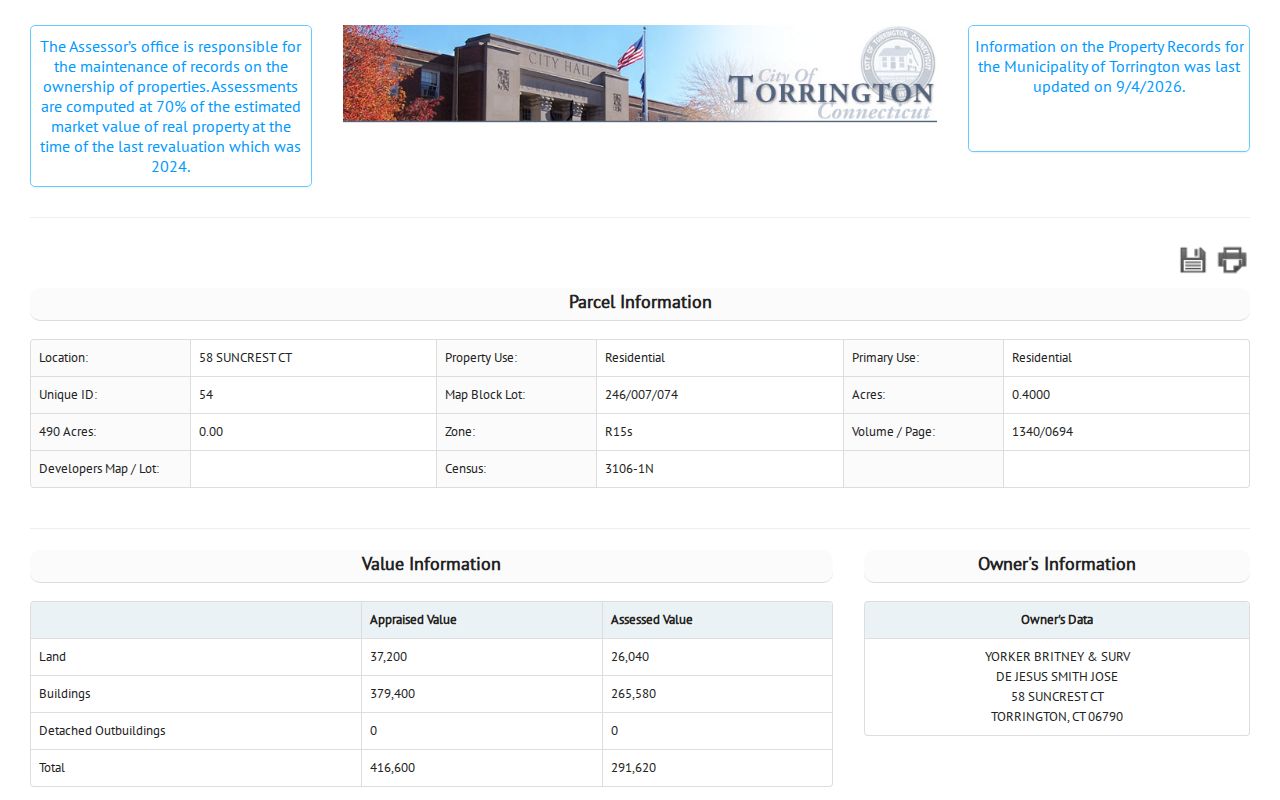
The image shows why the field label and effective date belong beside every number.
Watertown Property Tax Record Routes
Watertown's assessor card sample for 47 Clermont Avenue shows a 2023 appraised value of $279,200. The assessed value is $195,440, again 70 percent. The database notes a July 30, 2025 update. A 2004 sale row of $237,000 is not a current market estimate.
The Watertown Board of Assessment Appeals runs March hearings for real, personal, and supplemental lists. It also holds September hearings for regular motor vehicles. An assessment appeal is not a dispute over the tax bill, the board stresses. The collector handles real-estate installments due in July and January and publishes the municipal tax-sale route.
New Milford Property Tax Revaluation
The New Milford Assessor reports the 2025 revaluation complete. The Board of Assessment Appeals has a March 20, 2026 application deadline. That deadline comes from published appeal material. The assessor also names several relief categories. These include veteran, farm and forest, and elderly or disabled relief. Volunteer and other categories are listed too.
New Milford bills generally follow July 1 and January 1 installments. Real estate and personal property share that schedule. Online payment posting can take up to a week to clear. Check the live account instead of assuming a recent payment has posted.
Litchfield County Property Tax Snapshot
Torrington's guidance offers the clearest local example: the owner on October 1 controls the grand list. A later buyer shows up with the new grand-list billing. A deed recorded after that snapshot may be newer than the name on a tax bill. Run two clocks at once: a recording clock for the clerk and an assessment clock for the roll.
When names conflict, record the parcel key, bill year, assessment date, deed recording date, and both displayed names. The latest recorded deed can settle a recent transfer. The collector can explain which party is billed for that roll.
Note: A mortgage escrow payer or mailing addressee is not necessarily the fee owner of the parcel.
Litchfield County Tax Liens
Connecticut General Statutes §12-157 sets the municipal path for a tax sale. Notice comes first. The town files the notice with the clerk, sends certified mail, and publishes the required announcement. It names the taxpayer, property, amounts, and sale details. That paper alone settles little. It does not prove an auction ended in a completed conveyance, so pair collector status with town-clerk land records and review the parcel, account years, certificate reference, auction result, redemption record, tax deed, later releases, and any court challenge before inferring anything about character or wrongdoing.
Appeal Litchfield County Property Tax Values
A value dispute belongs at the local level. The assessor and the Board of Assessment Appeals hear it, not a county office. Read the local notice first. It lists the filing form, deadline, hearing schedule, and evidence rules. Good evidence ties back to the revaluation date. It uses the correct parcel identity, property characteristics, permit facts, photographs, and well-matched sales. An exemption request runs on a separate track. Relief may change the taxable amount while leaving the market appraisal and ownership untouched. Payment, interest, or posting disputes go to the tax collector instead.
Appeal window. Deadlines are municipal and time-sensitive. New Milford published March 20, 2026 for its 2025 revaluation; verify the live date and local board before filing.
Litchfield County Property Tax Exemptions
Exemptions sit on the assessment side of the property tax record. New Milford names its categories plainly. Veterans, farm and forest land, elderly or disabled owners, and volunteers all appear, along with other local and statutory programs. Torrington's list runs longer. It adds surviving spouses, blind owners, the totally disabled, active-duty service members, specially equipped vehicles, farmers, and merchant relief. Eligibility, forms, dates, and proof differ by town. A parcel card tells only part of the story. The public card may not display every exemption. Ask the local assessor which dated grand list holds the relief and how it moves the assessed or taxable amount. Never infer health, age, service, or finances from a lower bill. An exemption changes the tax math, not the deed owner, the parcel boundary, or the appraised market value. Compare Litchfield County property tax records piece by piece. Separate land and building appraisal, assessed value, exemption amount, mill rate, and final bill, because two similar parcels can land on different rolls, districts, or adjustments, and keep every figure tied to its own municipality and year.
Litchfield County Property Tax Disagreements
A paid status, a tax lien, a sale notice, and a deed are four different records. They answer different questions. Collector delinquency is a starting point. Check the account year and posting date, then search municipal land records for a lien certificate, notice, release, or later tax instrument. Connecticut's framework runs notice, clerk filing, publication, auction, then redemption. The first notice is never the last event. Name conflicts are common near a transfer. The assessor may keep the October 1 roll owner. The clerk may already hold a later deed. Record the taxpayer, billing address, assessor owner, grantee, parcel ID, roll date, and recording date as separate facts. A mailing address outside Litchfield County does not place the parcel there, and a postal locality inside the county does not fix the legal tax town. Some gaps need more than the portal. Use phone, mail, or the municipal counter when the dynamic payment system lacks an old year or a recent payment has not posted. A narrow Freedom of Information request can work. It can seek an existing nonexempt bill, lien filing, or assessment record. The agency does not have to build a title analysis or a custom market valuation, so keep the ask tied to records that already exist.