
Litchfield County Deed Records
Litchfield County keeps its deed records at the municipal level. Every town and city clerk records the instruments filed for land inside its own borders. There is no county recorder here. A recorded deed image in Litchfield County shows the grantor, the grantee, the instrument type, and the recording date. It also shows the legal description, any consideration language, and a prior reference. Index labels only point the way. Read the document itself to learn what it actually does.
| Deed Type | What It Does | Common Use |
|---|---|---|
| Warranty deed | Conveys the stated interest with deed covenants | Ordinary sale, subject to the actual terms |
| Quitclaim deed | Conveys whatever interest the grantor has | Family, entity, or title-cleanup transfer |
| Fiduciary deed | Transfer by an executor, administrator, or trustee | Estate or trust administration |
| Corrective deed | Corrects a stated error or reference | Name, description, or recording correction |
| Tax deed | Instrument following the statutory tax-sale process | Completed tax-sale chain, subject to review |
One Litchfield County index can hold all of it. Mortgages, assignments, releases, liens, easements, and lis pendens sit beside deeds in the same records. They are not equal in effect. A mortgage secures financing. A release clears a recorded claim. An easement grants only a limited use of the land, so check the clerk's document label. Keep that label until the full deed image confirms what the instrument truly does.
Litchfield County Deed Portal Fields
The Litchfield official land portal splits its holdings into Recorded Land and Maps. Users can narrow a property search by office, party, document type, and date range. Remember that this system belongs to the Town of Litchfield alone. It is not a countywide deed search. Its online land records begin in May 1979. Maps date from 1908, and early-1700s volumes remain in the office.
| Search control | Purpose | Check before relying |
|---|---|---|
| Office | Selects the municipal collection | Parcel lies in that town |
| Party name | Finds grantor or grantee entries | Name variants and entity form |
| Document type | Narrows deeds, liens, maps, or releases | Index label matches image |
| Date range | Limits recording dates | Online coverage reaches the target year |
The official land-record screen shows the municipal office and record-mode controls.
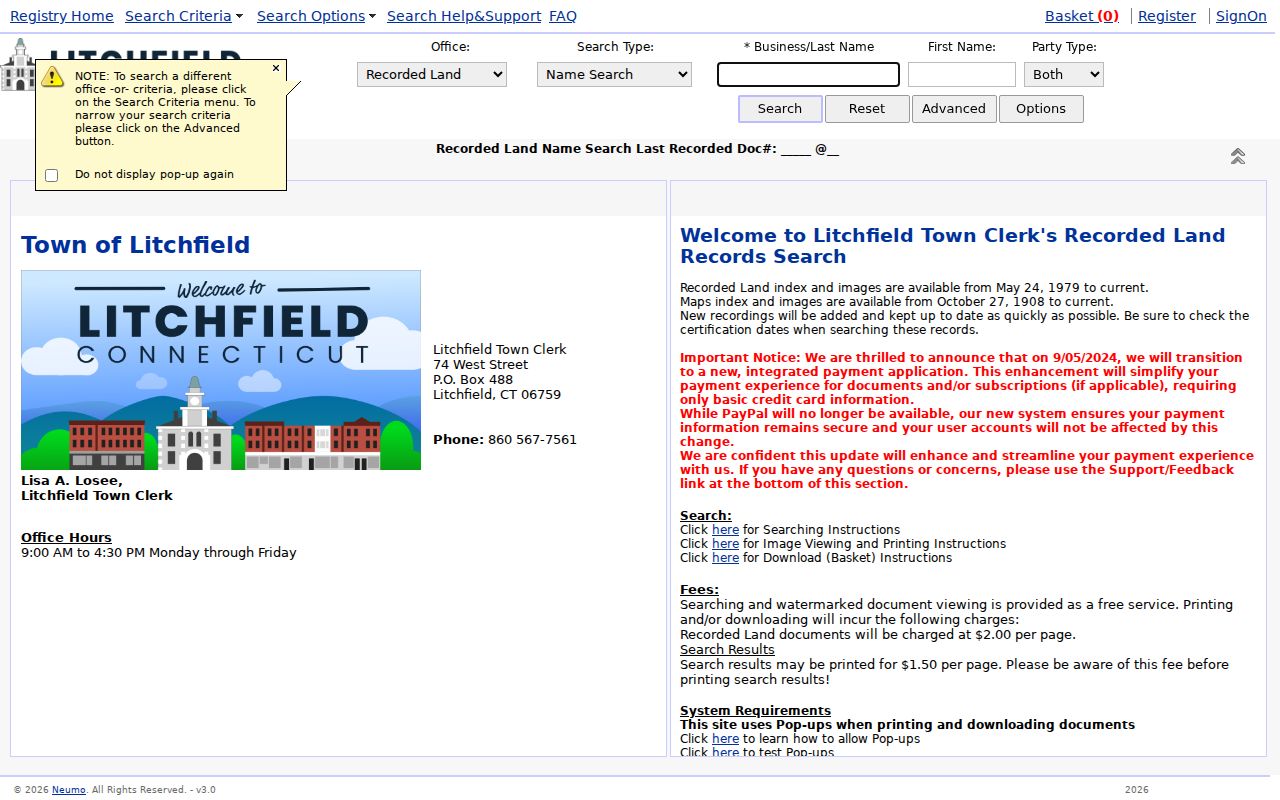
The screenshot shows the first rule of any Litchfield County deed search. Pick the right municipality before typing a party name.
Litchfield County Deed Index Chains
A grantor-grantee index tracks people and companies, not parcels by number. Start from the newest deed reference on the assessor card. Then search the current owner as grantee around that date and open the image. Confirm the legal description matches the parcel before you trust the match.
- Find the current acquisition deed with the owner listed as grantee.
- Read the grantor, legal description, recording stamp, and prior-deed reference.
- Search that grantor as a grantee in an earlier date span.
- Repeat while parcel descriptions remain continuous, then use office books beyond the portal cutoff.
- Grantor
- The party conveying the stated interest.
- Grantee
- The party receiving the stated interest.
- Chain of title
- The connected series of instruments for the same land.
- Book and page
- A clerk's recorded-document reference, distinct from an assessor MBL.
Litchfield County Deed Coverage Cutoffs
Record depth varies sharply across the county. Torrington reports historical index and image reach back to 1732 and 1733. New Milford holds records from 1712. Its online images start in 1918, and its searchable index in 1947. Litchfield keeps early-1700s books but publishes online land records only from 1979. Watertown's online index begins in 1996. Its older books still sit in the public vault.
Remember that an earliest-online year is not an earliest-held year. A chain may stop at a cutoff. Write down the last book, page, names, and year. Then visit or contact the municipal clerk for the earlier grantor-grantee index and deed volume. The Litchfield land-record guidance explains both online and in-house access.
Note: Historic coverage does not guarantee that every image is indexed, complete, legible, or downloadable.
Litchfield County Deed Name Variants
Copy trust, estate, entity, and joint-owner wording exactly as written. A deed may name an LLC. The Connecticut Secretary of the State business search can confirm its formal name and status. The entity's agent is not the parcel owner unless the deed says so. Fiduciary deeds may rest on probate authority that needs separate review.
Try spelling variants too. Search initials, survivor language, and prior entity names. Then anchor the match to the parcel. Use the deed description, map reference, assessor MBL, or a prior book and page. A name alone is weak evidence.
Liens Beside Litchfield County Deeds
A full chain review also covers liens. Look for mortgages and releases, assignments, and mechanic's liens. Search also for judgment liens, municipal tax liens, and notices of litigation. Easements, covenants, and condominium instruments belong here too. Each release should point back to the instrument it discharges. A release may be missing online. That is a search gap, not proof a lien still binds the property.
For litigation, pair a recorded lis pendens with the Connecticut Judicial Branch docket. The notice shows a case affecting land, not the outcome. For tax-sale work, read the notice, recorded certificate, and auction result. Read the redemption record and any resulting deed as part of the same file.
Litchfield County Deed Fraud Alerts
New Milford runs a service called PropertyCheck, and the Litchfield town clerk offers a similar alert tied to recorded names. Enroll and you get a notice whenever a matching name shows up in newly recorded material. That is the whole service. It cannot stop a filing. It also cannot judge whether a document is valid.
Enroll with the exact name forms that appear in the records, then check every alert against the official clerk index yourself. If a letter demands payment, verify it independently. Use contact details from the municipality's own website, never from the letter.
Order a Litchfield County Deed
When the municipal portal shows an image link, use it. If the image is missing, go to the clerk's public vault. If it predates the online coverage, do the same. You can also ask for the exact volume and page by phone or mail. Ask, too, what the clerk requires for a certified copy. Connecticut's FOI law reaches any existing nonexempt municipal record. An office does not have to build you a custom title search.
Litchfield posts free watermarked viewing. An online recorded-land print or download costs $2 per page. A search-result print is $1.50, and an in-house copy is $1. New Milford and Watertown each list $1 per page with $2 added for certification. Torrington's fee examples still need live confirmation. Fees change. Confirm with the municipality before you pay.
Recorded, not guaranteed. Litchfield County deed records show filed instruments, not a title opinion. Unrecorded interests, indexing gaps, and unresolved legal descriptions may require professional review.
Litchfield County Deed Description Checks
Matching a name is only the start. To tie a deed to the right parcel, weigh the town, the street or locality clues, the acreage, the map and lot, any subdivision name, the metes-and-bounds language, the adjoining owners, and the prior-deed reference. Then confirm the assessor MBL or list number against the GIS parcel. One owner of record can hold several tracts. A deed may also convey just part of a larger parcel or a limited interest.
Older descriptions take some translating. Wolcottville shows up in Torrington history. Gaylordsville, Northville, Lanesville, and Merryall mark areas within New Milford. Oakville, Westbury, and Guernseytown can point to Watertown. None of these is a separate county recorder jurisdiction. Old town-boundary references may likewise reflect historical splits involving Watertown, Plymouth, Thomaston, New Milford, Bridgewater, Litchfield, and Morris, so a locality name is a clue rather than a filing destination.
With a subdivision lot, compare the deed's map name, filing date, lot, and book or map reference against the recorded plat and the current GIS map. For an easement, pin down the benefited parcel, the burdened parcel, the scope, and the exhibit. The visible GIS line can orient a property search. It cannot replace the deed, the recorded map, or a survey when the legal boundary matters.
Litchfield County Deed Transfer Gaps
Not every ownership change shows up as a simple warranty-deed sale. A death can lead to survivorship or probate administration. It can also lead to a fiduciary deed, a distribution, or an estate sale. A trust transfer may use trustee language. A corporate transaction may keep one entity name across several filings. Read the stated authority in the deed records. Never infer legal effect from an assessor abbreviation.
Corrections and re-recordings interrupt a clean chain too. A corrective deed may fix a name, a date, a legal description, or a prior reference. A re-recorded instrument can carry a second recording stamp plus an explanation of what changed. Keep both references until the later document shows how they relate. An assignment can also move a mortgage or lease interest without conveying the parcel itself.
Assessor sales history can help you find a date, but it never substitutes for the recorded chain. Watertown's Loop Road sample mixes conventional price rows with later zero-dollar Certificate of Notice rows. That label must be inspected before anyone calls it a deed or a sale. Torrington's sample card likewise pairs a warranty-deed sale row with permit and revaluation dates. Those dates have no conveyancing effect. Treat card history as a frame for a clerk search. Then let the recorded image establish the parties, the instrument, the description, and the prior reference.
When an estate or fiduciary label appears, search the municipal grantor-grantee index around the relevant dates. Inspect the deed authority as well. Public probate records may add context. The correct probate district varies by municipality, though, and some material can be restricted. A death certificate alone does not transfer land. The recorded instrument remains the key step in the Litchfield County deed chain.