
Check the Litchfield County Current Owner Card
A present-owner search starts with one municipality's assessor card, not a county-wide roll in Litchfield County. Copy the owner-of-record labels exactly. Keep the source date for your notes.
| Owner's Data | Exact person, joint-owner, trust, estate, or entity string |
|---|---|
| Mailing Address | Correspondence destination, potentially different from situs |
| Situs and MBL/list ID | Physical parcel and municipal identifier |
| Deed Reference | Volume/page route to the recorded instrument |
| Card Dates | Update and revaluation dates qualifying the field |
Remember that the roll names an owner of record, not whoever lives at the property. Litchfield County municipalities list a mailing address as a record field for tax bills and notices. It should never be read as proof of residence. Treat it as data, nothing more.
Torrington Anchors a Litchfield County Owner
Torrington Property Record Cards lets a visitor search by owner. It also covers location, map-block-lot number, and unique ID. One example shows how much a single card can hold. The 58 Suncrest Court card ties its owner string to Unique ID 54 and MBL 246/007/074. It also lists 0.4000 acres, zone R15s, and volume/page 1340/0694. The card adds a 2021 warranty-deed sale row and the 2024 revaluation. That cluster of parcel, deed, and assessment facts carries far more weight. A lone name would tell you much less.
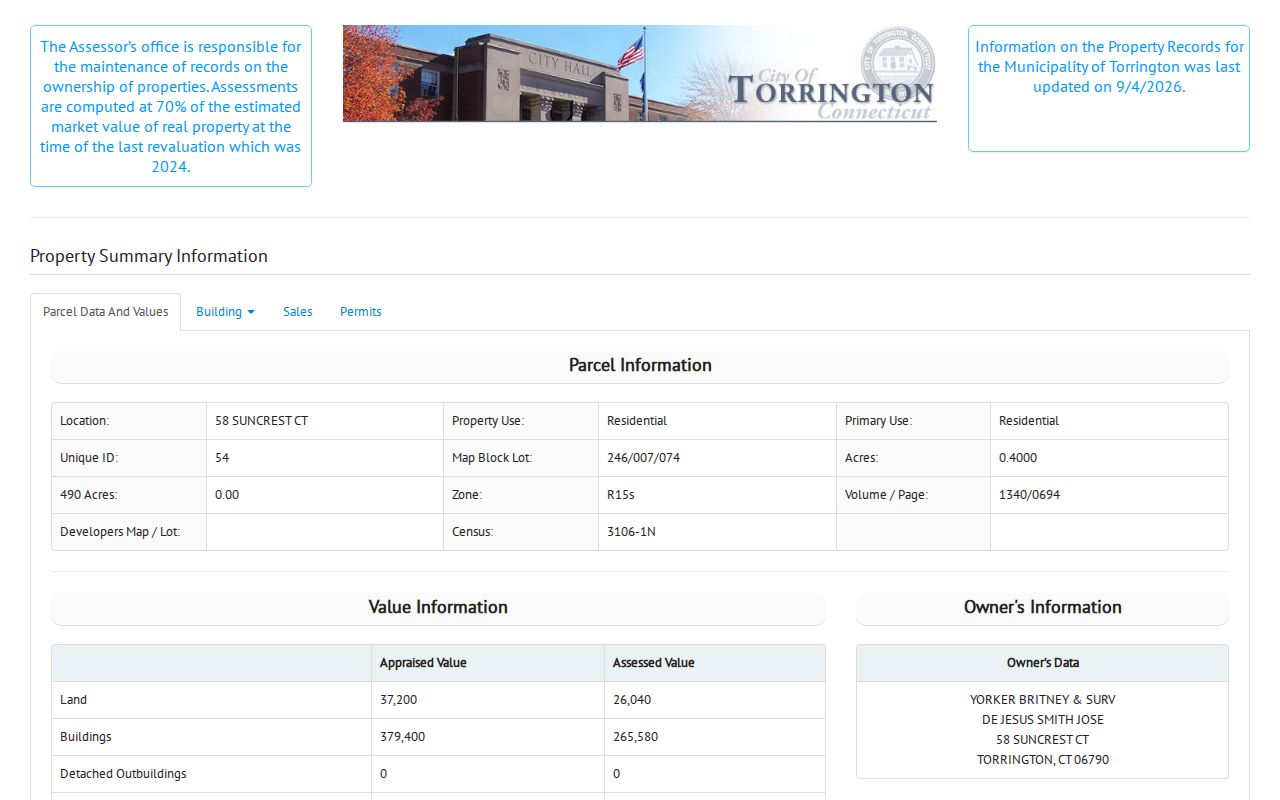
The Torrington example shows which identifiers and dates belong next to a current-owner statement. The sales row on the assessor card stays separate from the recorded deed image itself.
October 1 Dates Litchfield County Ownership
Connecticut assessors build each grand list around October 1. Torrington sets its rule plainly: whoever owned the parcel on October 1, 2025 controls that list, and a buyer shows up on new-list billing. Watertown frames its grand-list year as October 1 through September 30. Its most recent revaluation date is October 1, 2023. A deed recorded after the snapshot can still outrank the assessment roll.
Card refreshes, revaluations, deed recordings, and bill mailings each happen on their own schedule. Label them separately. Resist inventing one "last updated" date.
Watch the recent-sale gap. The roll can lag a conveyance; the newest recorded deed is the more current source when parcel and legal description match.
Confirm the Current Litchfield County Owner
Litchfield County has no county recorder. Deeds and other property records live with the town or city clerk for the municipality where the parcel sits, so confirm that jurisdiction and work from the clerk's recording volumes.
- Copy owner string, situs, MBL/list/unique ID, volume/page, and displayed dates.
- Search book/page, parties, and date in the municipal clerk's index.
- Read the newest deed image and match grantee and legal description to the parcel.
- Look for a later or corrective instrument when sources disagree and preserve the unresolved status.
- Owner of record
- The exact name displayed by the dated assessor source.
- Vesting
- The capacity or manner in which a recorded instrument identifies the grantee.
- Recording lag
- Time between receiving an instrument and its searchable appearance.
Watertown Separates Litchfield County Owner Addresses
Owner addresses and parcel locations in Litchfield County do not always match. A Watertown parcel on Clermont Street carries an Oakville mailing address. Yet Watertown is the municipal jurisdiction that holds the property records. Its field card shows Unique ID 000976, MBL 145 221 4, volume 1343 at page 0001. It also lists a card update dated July 30, 2025, and a 2023 revaluation. Another Watertown parcel on Loop Road shows a Brookfield mailing address. Its situs stays in Watertown.
Keep three labels separate: the postal locality, the situs municipality, and the recording municipality. A different correspondence city changes nothing about the clerk to contact. It also proves no occupancy and reveals no beneficial ownership.
Preserve Litchfield County Owner Labels
Current-owner fields in Litchfield County property records come in many forms. A card may list initials, a suffix, survivorship notation, or a trustee capacity. The owner of record could be an estate. It could also be an LLC, a corporation, or several joint owners. Preserve all punctuation and capacity exactly as recorded. Use any normalized spelling only as a separate property search variant.
For a business entity, the Connecticut business search can confirm the exact entity name. It also shows the entity's status. Registered-agent data is not title evidence, though. The recorded deed remains the controlling property record. Estate questions may call for probate records alongside the land records.
Check Litchfield County Current Owners Offline
Torrington and Watertown post assessor cards online. New Milford's official assessor route handles location, name, list number, street-listing, sales, and GIS searches. The owner of record may appear there too. Litchfield publishes a clerk portal. Its assessor card fields can be confirmed with the town itself.
A blank result or a conflict calls for a phone call. Ask the municipal assessor for the dated tax roll. Ask the clerk for the newest recorded deed. Older materials often live in office books. Watertown's online land records start in 1996. Litchfield and New Milford hold much earlier deed records. Connecticut FOI can request an existing non-exempt record. It cannot compel a custom title report.
Note: Save the portal URL and observation date because interfaces, card fields, and indexes change independently.
Resolve a Current-Owner Source Disagreement
A card and a deed can disagree. When the assessor card names one owner, the newest deed may name another grantee. Compare the parcel first, not the names. Match the complete situs, the MBL or list number, and the unique ID. Then match acreage, volume and page, and the legal description. Write down the deed's signed and recorded dates alongside the card's update and revaluation dates. A recent transfer may explain the gap. That stays a hypothesis until the same parcel and conveyance line up.
Search next for a later deed. Look also for a corrective or rerecorded instrument. Check for name variants created by punctuation, initials, joint ownership, or trustee capacity. The deed description may conflict with the GIS polygon. In that case, flag the result for a recorded plat or survey review. A permit, tax bill, or mailing address showing a different person belongs in its own record category. It does not replace the current owner source.
A concise evidence note should show the card was checked. It should also give the card date, the latest deed located, and possible roll lag. A blank field should read "not found; needs assessor or clerk." Never guess from a neighboring parcel.
Capture the Current Owner with a Dated Identity Packet
Assemble a current-owner packet before you trust any single field. It should carry the exact situs and postal locality. Add the legal municipality, the owner field, and the mailing address. Include the MBL or list ID and the GIS parcel ID. Round it out with acreage, zone, and the deed volume and page. Add the latest deed recording date, the card update, the revaluation date, and the GIS date. Anchor the conclusion to at least two independent sources. The parcel number paired with the deed citation works well.
Mark anything absent as “not found” or “needs clerk.” That habit pays off. It keeps a blank owner card, a neighboring polygon, or a familiar mailing address from quietly filling an evidence gap. It also surfaces condominiums, common elements, merged or split lots, private roads, and vacant tracts. Those call for a legal description or a recorded map. Litchfield County parcels often sit in complex subdivisions, so the paperwork matters.
Keep permits, zoning, tax roll data, and appraisal values in separate categories. A permit applicant may not own the land. A tax bill payer can differ from the deed grantee. A GIS label is not legal title. When dates disagree, record both clocks. Then explain the likely lag rather than turning it into a fact.
Use the Latest Recorded Instrument as the Deciding Check
The assessor's volume and page citation is a route, not a verdict. Open the instrument itself. Search forward by grantee and date for a newer deed or a correction. Compare the legal description against the same MBL, acreage, and situs. Be sure the paper matches the parcel. The online deed index may stop short of the cited volume. It may also lack an image. In that case, ask the municipal clerk for the page. Note the request date. Until that comparison finishes, call the name the assessor's dated current-owner field. An unqualified title statement has to wait.
Handle Litchfield County Owner Information Lawfully
Use Litchfield County owner information only for lawful purposes. That means purchase due diligence, an estate question, boundary coordination, deed-fraud prevention, or property history. Do not attach unrelated phone numbers, email addresses, birth dates, or sensitive data. Never treat a mailing address as proof of residence.
Connecticut's Safe at Home program gives eligible participants a substitute address. It does not erase every land record. Still, a protected actual address must never be republished or used to defeat the protection.
Lawful use. An owner field supports legitimate parcel research, not harassment, intimidation, surveillance, or publication of protected personal information.